

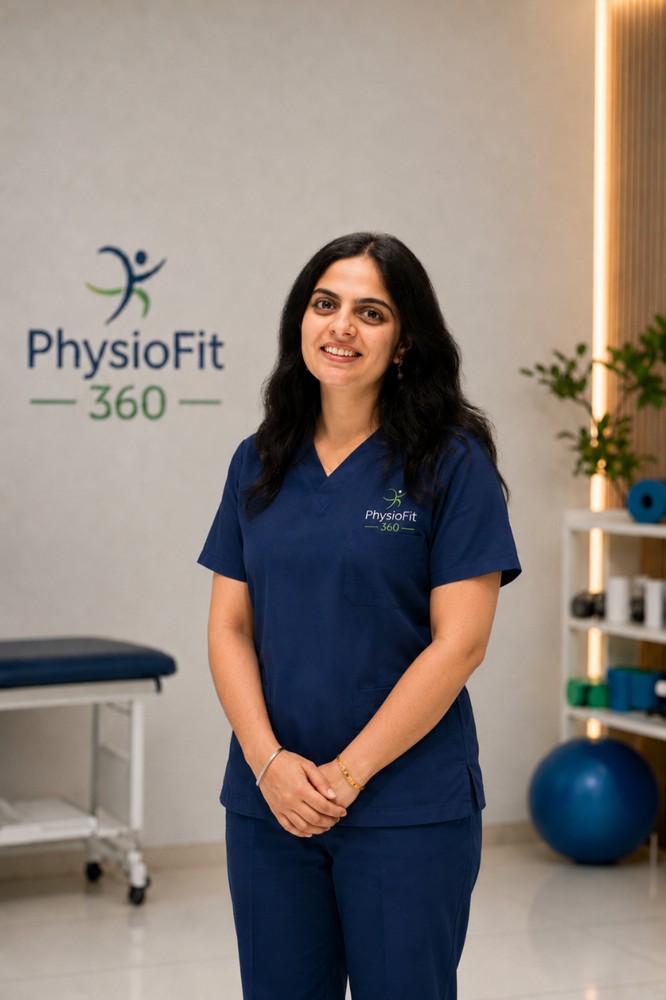
Dr. Sakshi Kochhar
Senior Physiotherapist
Physiotherapy, Rehabilitation & Functional Recovery
- Physiotherapy
- Rehabilitation
- Functional Recovery
- Patient-Centered Physiotherapy
- Movement Restoration
Professional Overview
Dr. Sakshi Kochhar is a Senior Physiotherapist at Physio Fit 360, with stated areas of practice in general physiotherapy, rehabilitation, functional recovery, patient-centred care and movement restoration.
General physiotherapy is broader than any single specialty and, in many ways, is the foundation the others build on. It is concerned with how people move, what limits that movement, and how capability can be rebuilt through assessment, exercise and education. The problems it addresses are varied — reduced mobility, difficulty with everyday tasks, deconditioning after a period of inactivity, or a general loss of confidence in movement.
Patient-centred physiotherapy describes an emphasis rather than a technique. It means that the goals guiding a rehabilitation plan come from the person themselves: what they need to do, what they have stopped doing, and what would represent meaningful progress in their own terms. Two people with similar physical findings may need very different plans because their lives ask different things of them.
Functional recovery and movement restoration are the practical objectives that follow. Within the Physio Fit 360 team, Dr. Sakshi's role reflects this broad, individually oriented approach to rehabilitation.
Specialization & Clinical Focus
General physiotherapy practice begins with a comprehensive assessment that considers the whole person rather than an isolated region. This usually includes movement and mobility, muscle strength, balance where relevant, the demands of the person's daily routine, and the activities they have reduced or avoided. That wider view often reveals contributing factors that a narrow assessment would miss.
Rehabilitation planning then translates those findings into a graded programme. Exercise selection is guided by what the person currently tolerates and what they need to achieve, with progression built in from the start. Where mobility is the limiting factor, range and flexibility work take priority; where capacity is the issue, strengthening does; and where confidence is the barrier, graded exposure to the task itself becomes central.
Functional recovery focuses on real activities rather than abstract measures. Getting out of a chair without assistance, walking a familiar distance, managing stairs, carrying shopping, returning to household or work tasks — these are the outcomes that define recovery for most people, and they make useful goals precisely because progress in them is easy to recognise.
Movement restoration ties these threads together. It involves re-establishing patterns that have been lost or altered, often through repeated practice of the movement itself with appropriate support and progression. Because these changes are gradual, general physiotherapy relies heavily on regular review: checking whether the programme is producing change, whether the goals still fit, and whether progression should be adjusted.
A patient-centred approach also means recognising when a concern falls outside physiotherapy's scope and should be discussed with the person's treating doctor.
Areas of Clinical Focus
Comprehensive Assessment
A whole-person evaluation covering mobility, strength, daily demands and avoided activities. Provides the basis for a rehabilitation plan that fits the individual.
Movement Restoration
Re-establishing movement patterns that have been lost, altered or avoided. Built on graded, repeated practice of the movements themselves.
Functional Recovery
Rehabilitation organised around real activities such as walking, stairs, standing and carrying. Progress is measured in tasks a person can perform.
Patient-Centred Planning
Goals set with the individual, based on what they need and value in daily life. Keeps rehabilitation relevant and easier to stay consistent with.
Strength & Conditioning
Progressive exercise to rebuild capacity lost during periods of reduced activity. Supports mobility, stability and everyday endurance.
Education & Self-Management
Practical explanation of the plan and how to maintain progress independently. Supports longer-term confidence with movement.
Rehabilitation Needs This Specialty Addresses
- General Rehabilitation
- Movement Restoration
- Mobility Improvement
- Functional Recovery
- Strength & Conditioning Support
- Confidence With Everyday Movement
- Individualised Rehabilitation Planning
Rehabilitation Goals
Rehabilitation goals in general physiotherapy are drawn directly from the person's own priorities. Early on, they usually involve restoring accessible movement and re-establishing a manageable level of daily activity, particularly where a period of rest or illness has reduced overall conditioning.
As tolerance improves, goals commonly extend to strength, mobility and endurance — the capacities that make everyday tasks feel routine rather than effortful. Balance and coordination may be included where they are relevant to safety and independence.
Functional goals are typically the most meaningful: managing stairs, walking a particular distance, returning to household responsibilities, sitting or standing for the length of a working day. Because these are concrete, they give a clear picture of progress and help maintain motivation over a longer programme.
Beyond the active phase, goals usually shift towards self-management: keeping a sustainable routine, understanding how to progress gradually, and knowing what to do when activity levels change. Individual outcomes depend on the underlying condition, medical guidance and consistency with the programme.
Who May Benefit From This Area of Physiotherapy?
General physiotherapy is relevant to a wide range of people whose everyday movement or activity level has become limited.
- People experiencing reduced mobility in daily activities
- Individuals rebuilding activity after a period of rest or reduced movement
- People working towards greater independence in everyday tasks
- Individuals seeking a structured, individualised rehabilitation plan
- People who have lost confidence in movement and want to rebuild it gradually
- Individuals looking to improve general strength, mobility and functional capacity
Approach to Physiotherapy
A patient-centred approach starts with listening. Understanding what a person's day involves, what they have stopped doing and what they most want back gives rehabilitation a purpose that generic goals cannot provide.
From there, plans are kept individualised and realistic. A programme that fits into someone's routine is more likely to be completed than an ideal one that does not, and consistency generally drives more change than complexity.
Progression is gradual and reviewed regularly. Because general rehabilitation often addresses several capacities at once — mobility, strength, endurance, confidence — the balance between them is adjusted as the person changes, rather than fixed at the outset.
Education runs alongside the exercise. Explaining why a task is being practised, what to expect during it, and how to progress independently helps people take ownership of their recovery. Where a concern sits outside physiotherapy's scope, referral back to the treating doctor is part of responsible practice, and expectations are always discussed openly.
Why This Specialty Matters
Loss of everyday function rarely announces itself. It usually appears as small adjustments — avoiding stairs, shortening a walk, asking for help with a task that used to be routine — and those adjustments accumulate quietly into a substantially smaller life.
General physiotherapy matters because it targets exactly this. By assessing broadly, setting goals that reflect real daily activity and progressing capacity gradually, it helps people recover function that might otherwise be written off as inevitable.
It also matters as a point of entry. Not every problem fits neatly into a specialty, and a broad, patient-centred assessment helps identify what a person actually needs — including when the most useful step is care from a differently focused clinician or a return to their treating doctor. That clarity is itself valuable to anyone unsure where to begin.
Part of the Physio Fit 360 Team
Working inside a multidisciplinary physiotherapy clinic means a patient is never limited to a single perspective. At Physio Fit 360, physiotherapists with different areas of specialisation — manual therapy, sports rehabilitation, orthopaedic care, neurological rehabilitation and general physiotherapy — practise under one roof in Sector 22B, Chandigarh. That shared environment makes it easier to match a person with the clinician whose focus best fits their rehabilitation needs, and to discuss a case collaboratively when a recovery journey touches more than one area. It also supports continuity: assessment, progression and review happen in the same place, with the same standards of care and communication. For patients, the practical benefit is straightforward — specialised attention within a team that understands rehabilitation as a shared, structured process rather than a series of isolated appointments.
Meet More of Our Team

Ready to Take the Next Step?
Connect with the Physio Fit 360 team to discuss your physiotherapy and rehabilitation needs.