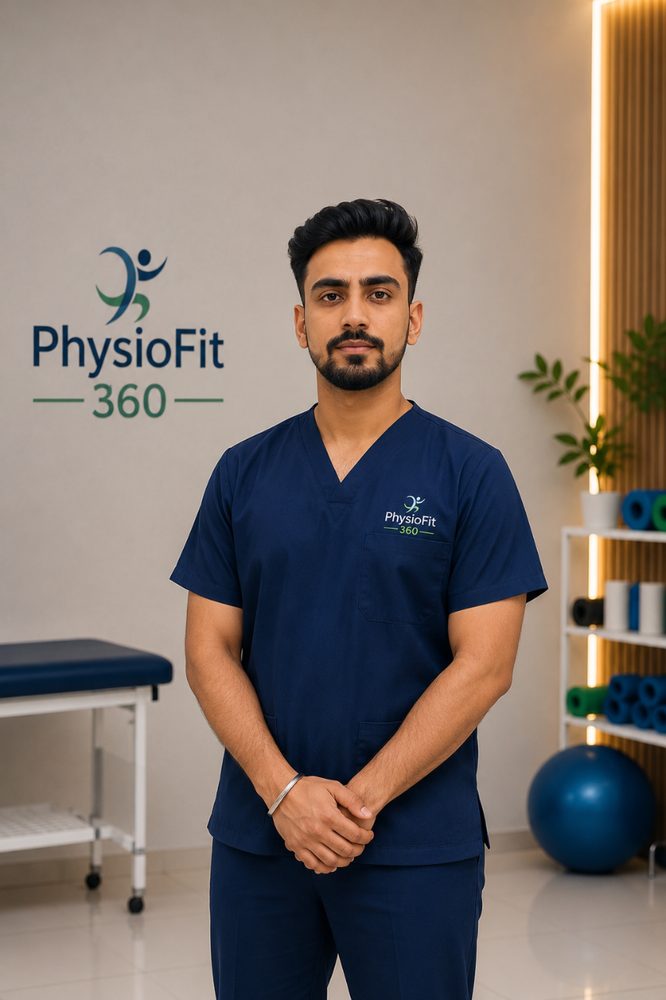
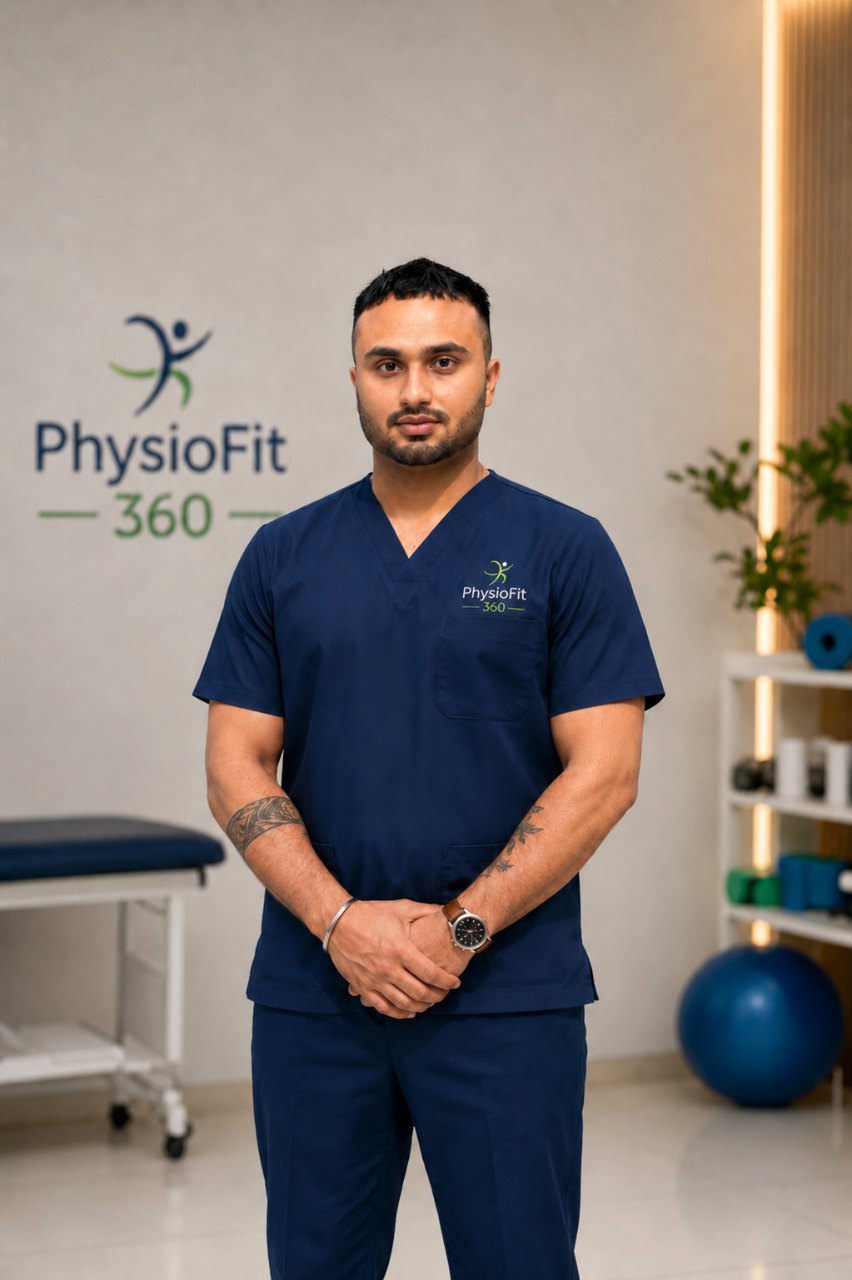
Dr. Ashish Choudhary
BPT, MPT (Sports)
Sports Physiotherapy & Functional Rehabilitation
- Sports Physiotherapy
- Sports Injury Rehabilitation
- Functional Rehabilitation
- Movement Recovery
- Sports Performance Support
Professional Overview
Dr. Ashish Choudhary holds a BPT and an MPT with a specialisation in Sports, and practises in sports physiotherapy and functional rehabilitation at Physio Fit 360.
Where sports physiotherapy is often described in terms of injury, its functional side is equally important: the question of how well a person actually moves, and whether their movement can support the demands they place on it. Functional rehabilitation examines tasks rather than isolated muscles — how someone squats, lands, pushes, rotates or transfers weight from one leg to the other — and builds rehabilitation around improving those patterns.
This matters in sport because performance and durability both depend on movement quality. A limb that is strong in isolation but poorly controlled during a landing behaves differently under real conditions. Rehabilitation in this area therefore combines strengthening with movement retraining, so capacity and coordination improve together.
Movement recovery describes the practical result: the ability to perform sport and everyday tasks with control and reasonable comfort. Performance support extends the same principles to the training environment. Within the Physio Fit 360 team, Dr. Ashish's stated focus places him in the sports and functional rehabilitation side of the clinic's work.
Specialization & Clinical Focus
Functional rehabilitation in a sports context begins with observing whole movements. Watching a squat, a step-down, a single-leg balance or a landing reveals information that isolated testing cannot: whether a knee tracks well under load, whether the trunk stays controlled during rotation, whether weight is shared evenly between limbs.
These observations translate directly into rehabilitation targets. If control breaks down at a particular depth or speed, that becomes the range in which work is concentrated. If one side consistently takes less load, restoring that balance becomes a priority, since asymmetry tends to concentrate demand on tissues that may not be ready for it.
Strengthening remains fundamental. Muscles and tendons need sufficient capacity before movement quality can hold up under fatigue, and progressive resistance work over weeks is what builds it. But the sequencing matters: strength developed without attention to how it is used often fails to transfer to the sport itself.
Progressive rehabilitation therefore layers demands. Controlled, slow movements come first; speed, reactivity, fatigue and unpredictability are added later, moving the environment closer to real sporting conditions. Deceleration and change of direction are usually introduced towards the end, as they place high demand on control.
Return-to-activity planning is criteria-based, considering range, strength, movement quality under fatigue and the person's confidence. Performance support then continues the same work in maintenance form — regular strength and movement-quality practice that keeps a person able to meet the demands of training. Results vary between individuals and cannot be guaranteed.
Areas of Clinical Focus
Movement Analysis
Observation of whole tasks such as squats, step-downs, landings and single-leg control. Identifies where movement quality breaks down under load or speed.
Functional Rehabilitation
Rehabilitation organised around movement patterns rather than isolated muscles. Aims to make improvements transfer into sport and daily activity.
Strength Development
Progressive resistance work to build the capacity that movement quality depends on. Sequenced so strength is trained and then applied to real tasks.
Asymmetry & Control
Attention to side-to-side differences in loading and control during functional tasks. Helps distribute demand more evenly during activity.
Sport-Specific Progression
Staged reintroduction of speed, reactivity, fatigue and change of direction. Moves rehabilitation closer to genuine sporting conditions.
Performance Support
Maintenance strength and movement-quality work once recovery is established. Supports the ongoing demands of regular training.
Rehabilitation Needs This Specialty Addresses
- Sports Injury Recovery
- Functional Rehabilitation
- Movement Quality & Control
- Strength & Conditioning Support
- Mobility Improvement
- Return to Physical Activity
- Performance-Oriented Rehabilitation
Rehabilitation Goals
Rehabilitation goals in functional sports physiotherapy tend to be described in terms of movement rather than symptoms alone. Early goals usually involve restoring the range needed for basic functional patterns and re-establishing controlled, comfortable weight-bearing where that has been affected.
The middle phase concentrates on strength and control together — building capacity while ensuring it is expressed with good technique. Improving symmetry between sides is a common goal here, as is maintaining movement quality as repetitions accumulate and fatigue sets in.
Later goals move towards the demands of the activity itself: performing sport-specific patterns at speed, decelerating and changing direction with control, and sustaining that quality across a training session. Improving confidence with these movements is treated as part of the goal, not a by-product of it.
Ongoing goals typically involve maintaining strength, mobility and movement quality so that regular training remains within tolerable limits. Individual outcomes depend on the underlying problem, adherence and other factors, and rehabilitation cannot guarantee freedom from future injury.
Who May Benefit From This Area of Physiotherapy?
This area of physiotherapy is generally relevant to physically active people who want their movement to hold up under real demand.
- Athletes and regular sports participants
- Gym-based trainees working on movement quality and strength
- People recovering from sports-related physical problems
- Individuals returning to activity who feel unsteady or uneven in movement
- Physically active people managing repeated demand from work or training
- Individuals working towards improved control, strength and performance
Approach to Physiotherapy
The general principles here begin with movement observation. Because rehabilitation targets patterns rather than isolated regions, understanding how a person performs a task is what makes the plan specific to them.
Rehabilitation is progressive and layered: control before speed, quality before volume, predictable tasks before reactive ones. Each layer is added when the previous one holds up reliably, which keeps progression grounded in demonstrated capability.
Patient participation is central. Movement retraining requires repetition and attention, and the individual is the one performing most of it. Explaining what a good repetition should feel like — and why it matters — usually improves both quality and consistency.
Regular review keeps the programme honest. Movement is re-checked as strength develops, and the plan is adjusted where transfer to real tasks is not occurring. Expectations are discussed realistically, with progress framed in terms of capability rather than promised outcomes.
Why This Specialty Matters
How a person moves determines how their body distributes load. Two athletes with identical strength scores can place very different demands on their joints and tendons depending on control, and that difference shows up over a season rather than in a single session.
Functional rehabilitation matters because it addresses this directly. Improving movement quality helps ensure that the strength a person builds is actually usable in their sport, and that demand is shared rather than concentrated in one area.
For anyone returning to activity, it also provides reassurance grounded in something visible. Seeing a landing become controlled, or a previously hesitant limb take load evenly, gives concrete evidence of progress — which supports both physical readiness and the confidence that has to accompany it.
Part of the Physio Fit 360 Team
Working inside a multidisciplinary physiotherapy clinic means a patient is never limited to a single perspective. At Physio Fit 360, physiotherapists with different areas of specialisation — manual therapy, sports rehabilitation, orthopaedic care, neurological rehabilitation and general physiotherapy — practise under one roof in Sector 22B, Chandigarh. That shared environment makes it easier to match a person with the clinician whose focus best fits their rehabilitation needs, and to discuss a case collaboratively when a recovery journey touches more than one area. It also supports continuity: assessment, progression and review happen in the same place, with the same standards of care and communication. For patients, the practical benefit is straightforward — specialised attention within a team that understands rehabilitation as a shared, structured process rather than a series of isolated appointments.
Meet More of Our Team
Ready to Take the Next Step?
Connect with the Physio Fit 360 team to discuss your physiotherapy and rehabilitation needs.