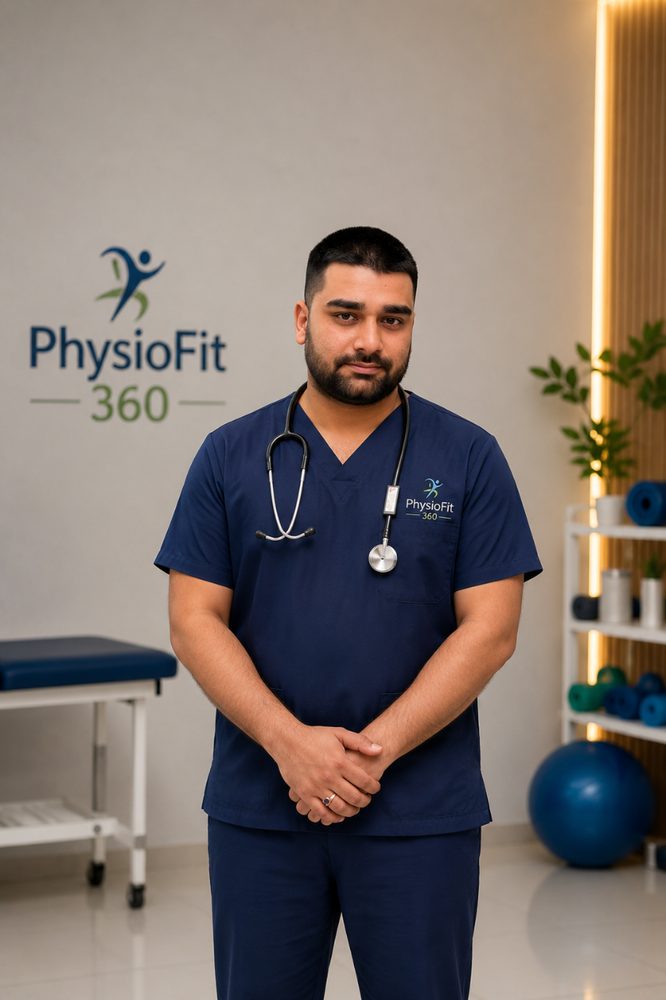
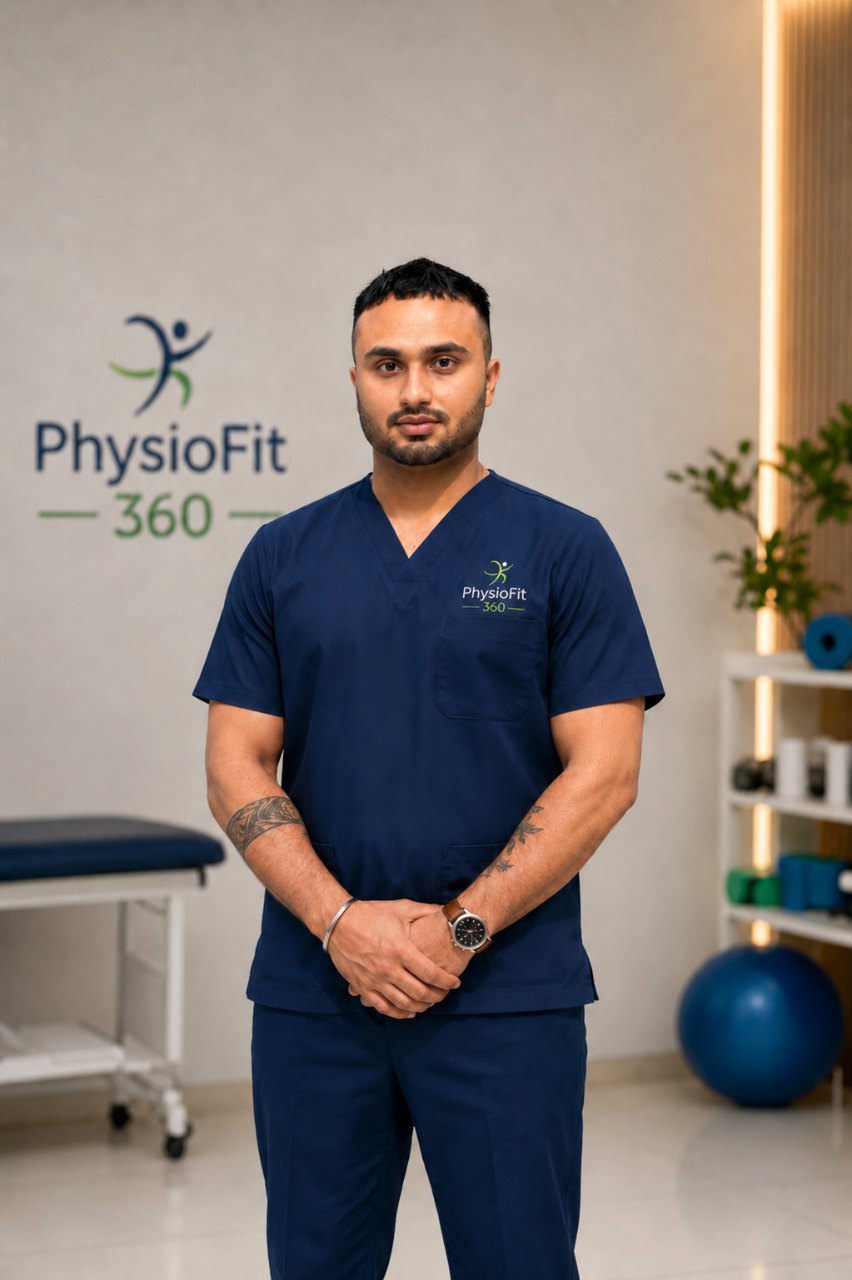
Dr. Parveen Lathwal
BPT, MPT (Sports)
Sports Physiotherapy & Sports Injury Rehabilitation
- Sports Physiotherapy
- Sports Injury Rehabilitation
- Functional Recovery
- Movement Rehabilitation
- Sports Performance Support
Professional Overview
Dr. Parveen Lathwal holds a BPT and an MPT with a specialisation in Sports, and works within sports physiotherapy and sports injury rehabilitation at Physio Fit 360.
Sports physiotherapy is the area of practice concerned with people whose bodies are placed under repeated physical demand — through training, competition, recreational sport, or physically demanding work. It deals with what happens when tissue is loaded more than it can currently tolerate, and with the structured process of rebuilding that tolerance afterwards.
Injury rehabilitation in this field is characteristically staged. There is an early phase focused on calming an irritable region and maintaining what movement is available; a middle phase focused on restoring range, control and strength; and a later phase focused on reintroducing speed, direction change, impact and the specific patterns of a person's sport or activity. Each stage is entered based on what the individual can currently do rather than on elapsed time.
Movement rehabilitation and functional recovery run through all of it, and performance support extends the same reasoning beyond recovery — using conditioning and movement work to help a person meet the physical demands of their activity. Within the Physio Fit 360 team, Dr. Parveen's stated focus sits firmly in this sports-oriented rehabilitation pathway.
Specialization & Clinical Focus
The physical demands of sport are specific, and rehabilitation has to respect that specificity. Running loads tendons and joints through repeated impact; field sports add acceleration, deceleration and rapid changes of direction; overhead sports place particular demand on the shoulder and trunk. Effective rehabilitation identifies which of these demands a person needs to return to and works backwards from them.
Assessment in sports physiotherapy therefore looks beyond the painful region. It typically examines available range, strength through relevant ranges, single-limb control, and the quality of movement during tasks such as squatting, hopping, landing or lunging. Comparing sides, where appropriate, gives a practical reference point for what a person is currently capable of.
Progressive rehabilitation is the core method. Load is increased gradually across sessions and weeks so that muscle and tendon can adapt, and complexity is layered on top — from controlled, predictable movement towards faster, less predictable, sport-like tasks. Attempting these later demands too early is a common reason recovery stalls; delaying them too long is equally limiting.
Return-to-activity decisions are guided by criteria: adequate range, sufficient strength, acceptable control during relevant tasks, and a settled response to progressive loading. Confidence is considered alongside physical readiness, since hesitancy during high-speed movement affects how a person performs and how they load their body.
Performance support continues after the immediate problem settles, focusing on maintaining strength, mobility and movement quality so that the demands of training remain within what the body can tolerate. Outcomes vary by individual, and rehabilitation is not a guarantee against recurrence.
Areas of Clinical Focus
Sports Injury Rehabilitation
A structured approach to restoring movement, strength and functional capacity after sports-related physical problems. Progression follows response rather than fixed dates.
Movement Assessment
Evaluation of squatting, landing, hopping and single-limb control to identify what a person can currently manage. Provides the baseline for progression.
Progressive Loading
Gradual increases in resistance, volume and speed so muscle and tendon can adapt over time. Central to durable recovery in sport.
Return to Sport
Criteria-based reintroduction of running, direction change and sport-specific patterns. Physical readiness and movement confidence are considered together.
Load Management
Guidance on balancing training demand with recovery during a rehabilitation phase. Helps reduce the likelihood of repeated setbacks.
Performance Support
Ongoing strength, mobility and movement-quality work once the immediate problem settles. Aims to keep training demands within tolerable limits.
Rehabilitation Needs This Specialty Addresses
- Sports Injury Recovery
- Movement Restoration
- Strength & Conditioning Support
- Mobility Improvement
- Return to Physical Activity
- Functional Rehabilitation
- Performance-Oriented Rehabilitation
Rehabilitation Goals
Rehabilitation goals in sports physiotherapy are usually defined by the activity a person intends to return to. Early goals centre on restoring available movement and maintaining general conditioning where possible, so that the wider body does not deteriorate while one region recovers.
Mid-stage goals concentrate on strength and control. Rebuilding the capacity of the affected region to accept load — and to do so with good single-limb control — is what allows later, faster tasks to be tolerated. Mobility work supports this where restricted range is limiting a functional pattern.
Later goals address the specific demands of the sport or activity: running mechanics, acceleration and deceleration, jumping and landing, and changes of direction. Alongside these, confidence with movement is treated as a genuine objective, since hesitancy alters how a person moves under speed.
Longer-term goals typically include maintaining strength and mobility through continued conditioning and understanding how to manage training load sensibly. Recovery timelines vary between individuals, and no rehabilitation programme can guarantee a particular result or prevent future injury.
Who May Benefit From This Area of Physiotherapy?
Sports physiotherapy is generally relevant to people whose goals involve physical activity and who want to move, train or compete with greater capacity.
- Athletes and competitive sports participants
- Recreational sports players and gym-based trainees
- Physically active individuals recovering from sports-related physical problems
- People returning to running or training after a period away
- Individuals whose work involves repeated physical demand
- People working towards improved movement quality and physical performance
Approach to Physiotherapy
Sports rehabilitation is generally built around clear, activity-specific goals. Knowing what a person is training for — a sport, a return to running, a physical job — determines what the final stages of rehabilitation must include, and that endpoint shapes the plan from the first session.
Progression is criteria-based. Rather than advancing on a schedule, the next stage is introduced when the person demonstrates the range, strength and control it requires. This tends to reduce setbacks and gives both clinician and patient an objective way to discuss readiness.
Active participation is essential in this field. Much of the work is exercise the individual performs independently, so programmes are kept practical and the reasoning behind them explained. Understanding what an acceptable response to loading feels like helps people continue with confidence rather than stopping at the first sign of discomfort.
Consistency generally matters more than intensity. Regular, well-judged loading over weeks produces adaptation; sporadic heavy sessions rarely do. Plans are reviewed and adjusted as capacity changes, and outcomes are discussed honestly rather than promised.
Why This Specialty Matters
Physical activity is central to long-term health, and a sports-related physical problem often does more than interrupt training — it can end a person's relationship with an activity entirely if the return is handled poorly. Sports physiotherapy matters because it provides a structured route back rather than leaving that return to chance.
The staged nature of this work is what makes it valuable. Returning to sport too early risks a repeat setback; returning too late leaves capacity and confidence unnecessarily diminished. A criteria-based process helps navigate between the two, and gives people a clear sense of where they are in their recovery.
There is a broader benefit too. The strength, mobility and movement-quality work that supports return to sport also supports general physical resilience, helping people stay active in the long run rather than cycling between injury and rest.
Part of the Physio Fit 360 Team
Working inside a multidisciplinary physiotherapy clinic means a patient is never limited to a single perspective. At Physio Fit 360, physiotherapists with different areas of specialisation — manual therapy, sports rehabilitation, orthopaedic care, neurological rehabilitation and general physiotherapy — practise under one roof in Sector 22B, Chandigarh. That shared environment makes it easier to match a person with the clinician whose focus best fits their rehabilitation needs, and to discuss a case collaboratively when a recovery journey touches more than one area. It also supports continuity: assessment, progression and review happen in the same place, with the same standards of care and communication. For patients, the practical benefit is straightforward — specialised attention within a team that understands rehabilitation as a shared, structured process rather than a series of isolated appointments.
Meet More of Our Team
Ready to Take the Next Step?
Connect with the Physio Fit 360 team to discuss your physiotherapy and rehabilitation needs.