

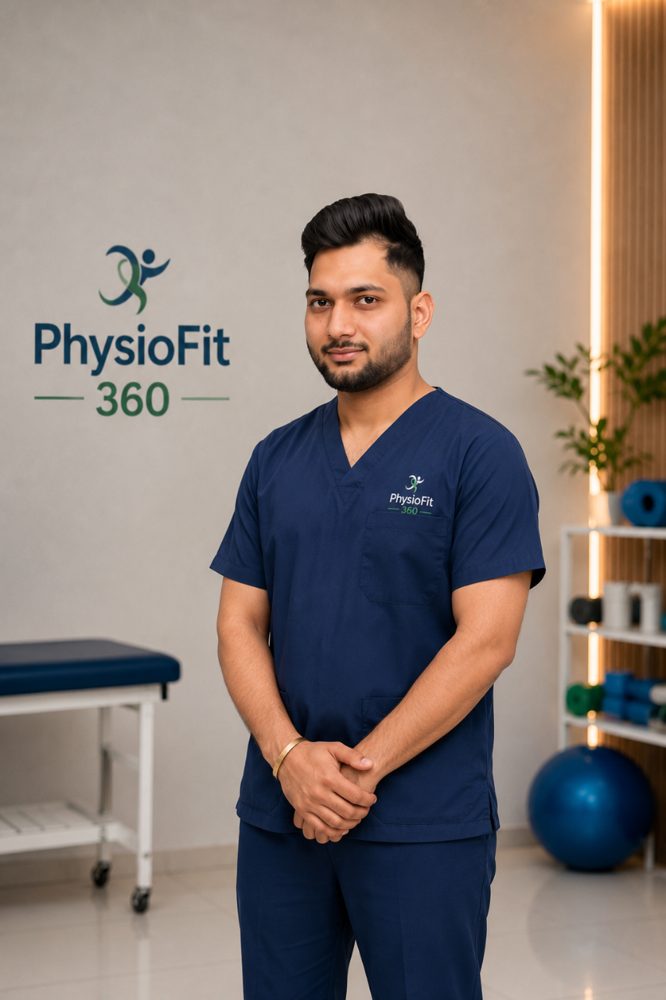
Dr. Diksha Sharma
Consultant Physiotherapist
Physiotherapy Consultation & Individualised Rehabilitation
- Physiotherapy Consultation
- Rehabilitation
- Functional Recovery
- Individualized Physiotherapy Care
- Movement Restoration
Professional Overview
Dr. Diksha Sharma is a Consultant Physiotherapist at Physio Fit 360, with stated areas of practice in physiotherapy consultation, rehabilitation, functional recovery, individualised physiotherapy care and movement restoration.
Physiotherapy consultation is the part of care where direction is set. Before any programme begins, someone has to establish what the actual limitation is, what the person needs to be able to do, what has already been tried, and which form of rehabilitation is likely to help. A thorough consultation turns a vague complaint — difficulty walking, discomfort during work, reduced activity — into a clear, workable plan with defined goals.
Individualised care is the natural consequence of that process. Once a person's specific limitations, priorities and daily demands are understood, the rehabilitation plan can be built around them rather than adapted from a template. This includes deciding not only which exercises are appropriate but how often, at what intensity, and how they fit into a realistic week.
Functional recovery and movement restoration are the objectives that the consultation serves. Within the Physio Fit 360 team, Dr. Diksha's stated focus centres on this consultative, individually planned approach to rehabilitation.
Specialization & Clinical Focus
A physiotherapy consultation typically begins with a detailed history: what the person is finding difficult, how it has changed over time, what makes it better or worse, and what activities have been reduced as a result. This context often shapes the plan as much as the physical examination does.
The examination then looks at movement and function — available range, strength, the quality of relevant movement patterns, and performance of specific tasks the person struggles with. The aim is to identify which factors are actually limiting the activity in question, since the most obvious finding is not always the most important one.
From this, an individualised rehabilitation plan is constructed. Planning involves choices about emphasis: whether mobility, strength, control or graded activity should lead; how quickly progression is likely to be tolerated; and which exercises are realistic given the person's schedule and circumstances. A well-designed plan is one the individual can actually follow.
Goal setting is a defined part of the consultative process. Goals are stated in functional terms — walking a certain distance, sitting through a working day, returning to a household or recreational activity — so progress is recognisable to the person, not just measurable in the clinic.
Review closes the loop. Follow-up consultations examine whether the plan is producing change, whether progression should be adjusted, and whether goals need revising. Where a concern falls outside physiotherapy's scope, the appropriate step is to refer back to the person's treating doctor. Outcomes vary with the underlying condition, medical guidance and consistency with the plan.
Areas of Clinical Focus
Detailed Consultation
A structured history and examination to clarify what is limiting a person's activity. Provides the basis for a plan with defined, functional goals.
Individualised Planning
Rehabilitation designed around the person's specific limitations, priorities and weekly routine. Built to be realistic and followable.
Functional Goal Setting
Goals expressed as activities rather than measurements, such as walking distance or a full working day. Makes progress recognisable to the individual.
Movement Restoration
Graded work to rebuild movement patterns that have been reduced or avoided. Progression is matched to demonstrated tolerance.
Progression & Review
Regular reassessment to check whether the plan is producing change. Emphasis and intensity are adjusted according to response.
Education & Guidance
Clear explanation of the plan, expected responses and self-management between sessions. Supports informed participation in recovery.
Rehabilitation Needs This Specialty Addresses
- Physiotherapy Assessment & Consultation
- Individualised Rehabilitation Planning
- Functional Recovery
- Movement Restoration
- Mobility Improvement
- Progression & Review of Rehabilitation
- Guidance on Self-Management
Rehabilitation Goals
In consultative physiotherapy, goal setting is itself a core part of the work. Initial goals usually address the most limiting problem — restoring a specific movement, managing a particular daily task more comfortably, or re-establishing a baseline level of activity.
Intermediate goals typically build capacity: improving mobility where range is limiting, strength where capacity is limiting, and tolerance where activity has been reduced. The balance between these is decided during consultation and adjusted as the person responds.
Functional goals remain the reference point throughout. Being able to complete a working day, walk a familiar route, manage stairs comfortably, or return to a valued activity gives both clinician and patient a clear measure of whether rehabilitation is doing what it should.
Later goals generally focus on independence: maintaining progress with a sustainable routine, recognising how to progress safely, and understanding when to seek review. Because plans are individualised, timelines and outcomes differ between people and depend on the underlying condition and medical advice.
Who May Benefit From This Area of Physiotherapy?
Consultative physiotherapy is generally useful for people who want clarity about their situation and a structured plan to work from.
- People unsure which form of rehabilitation would suit their situation
- Individuals seeking a detailed assessment and a clear rehabilitation plan
- People whose everyday activity has become limited and want structured guidance
- Individuals who have been exercising without clear direction or progression
- People wanting their rehabilitation reviewed and adjusted over time
- Individuals looking for guidance on managing movement independently
Approach to Physiotherapy
A consultative approach places assessment and planning at the centre. Time spent understanding the person's situation, priorities and constraints tends to produce a more effective plan than moving straight to exercise prescription.
Plans are individualised rather than standardised, and deliberately realistic. An exercise programme that fits a person's actual week is more valuable than a comprehensive one they cannot sustain, so practicality is treated as a clinical consideration.
Patient participation is built in through shared goal setting. When people help define what recovery should look like, the plan tends to reflect what genuinely matters to them, and engagement is generally better as a result.
Progression and review are structured rather than incidental. Plans are revisited at intervals, adjusted according to response, and coordinated with the person's treating doctor where a concern falls outside physiotherapy's scope. Expectations are discussed openly, without promising particular outcomes.
Why This Specialty Matters
A great deal of rehabilitation fails not because the exercises were wrong but because the plan was never clearly defined — no baseline, no goals, no progression, no review. Consultation matters because it supplies exactly those elements.
For the individual, the value is clarity. Knowing what is limiting them, what the plan is intended to achieve, roughly how long it may take and what progress should look like removes much of the uncertainty that makes people abandon rehabilitation early.
There is also an efficiency benefit. A well-directed plan focuses effort where it is most likely to help, avoids unnecessary interventions, and identifies when a different specialty or a return to the treating doctor is the more appropriate step. For anyone unsure where to begin, that direction is often the most useful outcome of a first appointment.
Part of the Physio Fit 360 Team
Working inside a multidisciplinary physiotherapy clinic means a patient is never limited to a single perspective. At Physio Fit 360, physiotherapists with different areas of specialisation — manual therapy, sports rehabilitation, orthopaedic care, neurological rehabilitation and general physiotherapy — practise under one roof in Sector 22B, Chandigarh. That shared environment makes it easier to match a person with the clinician whose focus best fits their rehabilitation needs, and to discuss a case collaboratively when a recovery journey touches more than one area. It also supports continuity: assessment, progression and review happen in the same place, with the same standards of care and communication. For patients, the practical benefit is straightforward — specialised attention within a team that understands rehabilitation as a shared, structured process rather than a series of isolated appointments.
Meet More of Our Team


Ready to Take the Next Step?
Connect with the Physio Fit 360 team to discuss your physiotherapy and rehabilitation needs.